Class KG English Worksheet on Uppercase Letter Tracing
Class 4EnglishEnglish GrammarFree DownloadPDF

Kajal MishraVisit Profile
I am an enthusiastic and dedicated English educator at PlanetSpark. I am passionate about helping students develop strong communication and public speaking skills while building their confidence and creativity. My teaching approach focuses on making learning fun, interactive, and meaningful so that every student feels inspired to express themselves effectively in English.
Class KG English Worksheet on Uppercase Letter Tracing
Class 4EnglishEnglish GrammarFree DownloadPDF
Kajal MishraVisit Profile
I am an enthusiastic and dedicated English educator at PlanetSpark. I am passionate about helping students develop strong communication and public speaking skills while building their confidence and creativity. My teaching approach focuses on making learning fun, interactive, and meaningful so that every student feels inspired to express themselves effectively in English.
Trace & Shine: Uppercase Letter Tracing A–Z for KG
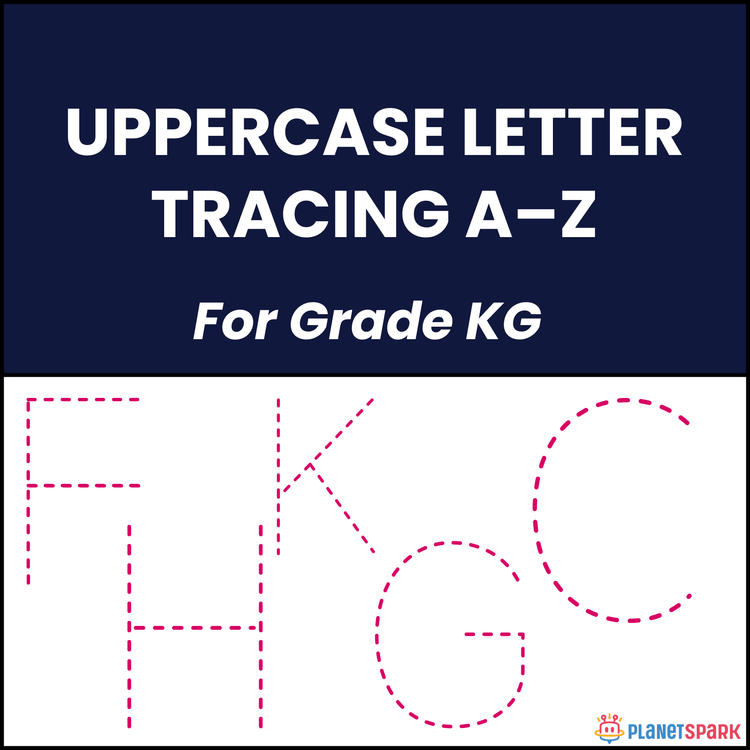
This Kindergarten worksheet on Uppercase Letter Tracing A–Z helps young learners practise capital letter formation in a structured and engaging way. Designed especially for KG students, this worksheet builds early writing confidence by guiding children to trace letters carefully, follow starting dots, and develop proper stroke direction.
Through grouped tracing exercises (A–F, G–L, M–R, S–Z, and start-from-the-dot practice), children strengthen fine motor control, pencil grip, and letter recognition skills. The repeated tracing patterns help build muscle memory and correct letter formation habits from an early stage.
Why Uppercase Letter Tracing Matters in Early Learning?
Practising capital letters helps children:
1. Develop correct letter formation and stroke order.
2. Strengthen pencil control and hand coordination.
3. Improve alphabet recognition and sequencing.
4. Build readiness for independent writing.
What’s Inside This Worksheet?
🧠 Exercise 1 – Trace Capital Letters (A–F)
Children carefully trace uppercase letters A, B, C, D, E, and F multiple times to practise correct formation.
✏️ Exercise 2 – Trace Capital Letters (G–L)
Students trace letters G, H, I, J, K, and L with dotted guidelines for smooth movement.
📋 Exercise 3 – Trace Capital Letters (M–R)
Children practise tracing M, N, O, P, Q, and R, focusing on straight and curved strokes.
🔤 Exercise 4 – Trace Capital Letters (S–Z)
Students trace S, T, U, V, W, X ,Y and Z carefully, paying attention to curves and slanting lines.
🔘 Exercise 5 – Start Tracing from the Dot
Children trace letters A–P again, beginning from marked dots to reinforce correct starting points and stroke direction.
ANSWER KEY (For Parents & Educators)
Exercise 1 – Letters Traced
A B C D E F
Exercise 2 – Letters Traced
G H I J K L
Exercise 3 – Letters Traced
M N O P Q R
Exercise 4 – Letters Traced
S T U V W X Y Z
Exercise 5 – Letters Traced from Starting Dot
A B C D
E F G H
I J K L
M N O P
(Tracing accuracy may vary depending on fine motor development stage.)
Help your child master capital letter formation with structured, step-by-step tracing practice designed especially for Kindergarten learners.
🔖Book a free trial!
Frequently Asked Questions
It helps them recognise and write capital letters correctly.
It builds letter formation skills and alphabet awareness.
They are usually taught before lowercase letters for clarity.