
Class 6 English Worksheet on Present Perfect Tense

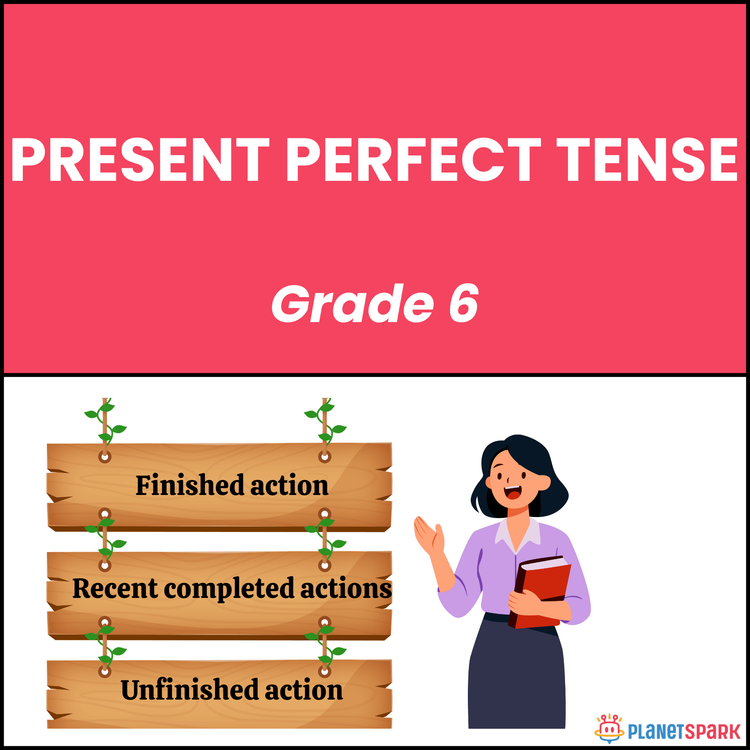
Class 6 English Worksheet on Present Perfect Tense
Correcting Present Perfect Tense Usage: Exercises for Grade 6
This Grade 6 worksheet focuses on helping students understand and correctly use the Present Perfect Tense in English. The exercises are designed to reinforce proper sentence formation, identify common errors, and practice rewriting sentences to improve grammatical accuracy. By engaging with these activities, learners will develop confidence in recognizing and applying the Present Perfect Tense in both written and spoken English.
Why Present Perfect Matters in Grammar?
The Present Perfect Tense is essential for expressing actions that have been completed recently or at an unspecified time before now. For Grade 6 students, mastering this tense is important because:
1. It helps describe experiences and actions relevant to the present.
2. Correct usage improves clarity and precision in communication.
3. Understanding this tense enhances overall grammar skills and writing fluency.
4. It prepares students for more advanced grammar concepts and effective storytelling.
What’s Inside This Worksheet?
This worksheet includes various exercises designed to help students practice and understand the correct use of the Present Perfect Tense:
🧠 Exercise 1 – Multiple Choice Questions
Students will choose the correct form of the verb in Present Perfect tense to complete sentences. (Pages 3–4)
✏️ Exercise 2 – True or False
Students will decide whether sentences correctly use the Present Perfect Tense. (Page 5)
📋 Exercise 3 – Fill in the Blanks
Students will fill in blanks with the correct Present Perfect form of given verbs. (Page 6)
📝 Exercise 4 – Sentence Rewriting
Learners will rewrite sentences, changing them into the Present Perfect tense as directed. (Pages 7–8)
🎯 Exercise 5 – Paragraph Completion
Students will read a paragraph and fill in missing verbs with the correct Present Perfect forms to complete the story. (Page 9)
✅ Answer Key (For Parents & Educators)
Exercise 1 – Multiple Choice
1. a) She has gone to school.
2. b) He has finished his homework.
3. b) I have eaten breakfast.
4. a) They have visited the museum.
5. b) We have watched the movie.
6. b) You have completed the task.
7. a) Riya has played cricket.
8. a) They have arrived at the station.
9. b) She has read the book.
10. a) I have completed the task.
Exercise 2 – True or False
1. T
2. F ("They have finished their work.")
3. T ("She has completed her homework.")
4. T
5. F ("I have watched that movie.")
6. T
7. T
8. F ("You have met my friend.")
9. F ("She has cooked dinner.")
10. T
Exercise 3 – Fill in the blanks
1. Have you ever been to Mumbai?
2. They have played cricket before.
3. He has finished his homework.
4. She has eaten lunch.
5. We have been to the museum.
6. I have seen that movie.
7. They have visited the park.
8. I have read the book.
9. You have visited Delhi.
10. He has gone to school.
Exercise 4 – Sentence Rewriting
1. She has gone to the market.
2. They have been playing football.
3. He has read books.
4. They have traveled to Delhi.
5. We have played cricket.
6. She has watched movies.
7. They have gone to the park.
8. He has studied every day.
9. She has eaten lunch at noon.
10. They have been reading a book.
Exercise 5 – Paragraph Completion ( Answer)
I have completed all my homework for the week. I have read a new book, and it has been amazing so far. I have visited my grandparents recently, and we have had a wonderful time together. This morning, I have eaten breakfast early, and I have gone for a run. I have not seen my friends in a few days, but we have planned to meet tomorrow. I have learned so much this week, and I'm excited for what's to come. I have made progress in my studies, and I have felt proud of myself. I have watched a great movie last night, and it has been so much fun. I have started a new project, and I have enjoyed every moment of it.
```
Help your child grasp the correct usage of the Present Perfect Tense with these practical exercises.
Frequently Asked Questions
The present perfect tense connects past actions with the present and uses "have/has" with the past participle.
To make it negative, simply add "not" after "have" or "has," e.g., "I have not seen that movie."
Focusing on linking past actions to the present, such as "I have finished my homework," which emphasizes the result.