
Class 6 Grammar Worksheet on Adjective-Noun Pairs

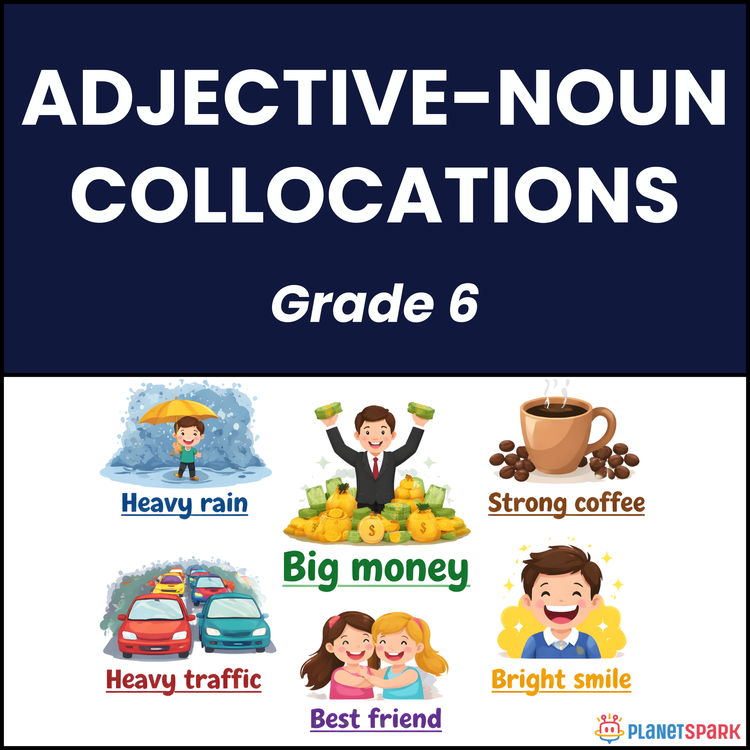
Class 6 Grammar Worksheet on Adjective-Noun Pairs
Adjective-Noun Collocations for Class 6
This Grade 6 worksheet focuses on understanding and using adjective-noun collocations. Collocations are combinations of words that sound natural together. In this worksheet, students will practice identifying the correct adjective-noun pairs and using them to improve their sentence structure and fluency.
Adjective-noun collocations are essential for writing and speaking fluently. Students will learn how to match adjectives with nouns appropriately, ensuring their sentences sound natural and express their ideas more clearly. This worksheet includes engaging exercises like True/False statements, matching, filling in the blanks, and rewriting sentences with stronger collocations.
Why Adjective-Noun Collocations Matter in Grammar?
Adjective-noun collocations are important because:
1. They improve the naturalness of written and spoken language.
2. They help students convey meaning more clearly by pairing adjectives with suitable nouns.
3. Mastering them helps in sounding more native-like in language use.
4. They enhance the readability and coherence of sentences.
What’s Inside This Worksheet?
This worksheet offers five different exercises to help learners build their understanding of adjective-noun collocations:
Exercise 1 – True or False
Students read each statement about adjective-noun collocations and mark whether it’s true or false. This helps them practice identifying correct collocations.
Exercise 2 – Match the Following
Students match adjectives from one column to the appropriate nouns in another. This exercise helps reinforce the correct adjective-noun pairings.
Exercise 3 – Fill in the Blanks
Students fill in the blanks of sentences with appropriate adjective-noun collocations. This helps improve their ability to use these collocations in context.
Exercise 4 – Multiple Choice Questions
Students select the correct adjective-noun collocation from multiple choices. This allows them to practice choosing the right combinations.
Exercise 5 – Sentence Rewriting
Students rewrite sentences using stronger adjective-noun collocations. This helps them improve the expressiveness and clarity of their writing.
Answer Key (For Parents & Educators)
Exercise 1 – True or False
1. False
2. True
3. True
4. True
5. False
6. True
7. False
8. False
9. True
10. False
Exercise 2 – Match the Following
1. Quiet - Library
2. Festive - Decoration
3. Square - Table
4. Fast - Runner
5. Heavy - Stone
6. Dirty - Clothes
7. Small - Flower
8. Smooth - Surface
9. Shiny - Light
10. Cold - Snow
Exercise 3 – Fill in the Blanks
1. Elegant
2. Beautiful
3. Old
4. Tall
5. Lively
6. Warm
7. Sharp
8. Heavy
9. Clean
10. Comfortable
Exercise 4 – Multiple Choice
1. b) Heavy rain
2. a) Strong coffee
3. d) Deep breath
4. b) Clear weather
5. b) Heavy traffic
6. a) Tall building
7. c) Bright smile
8. a) Fast car
9. b) Loud music
10. c) Bright light
Exercise 5 – Sentence Rewriting (Stronger Adjective-Noun Collocations)
1. The hikers got wet because of the heavy rain.
2. Solving the puzzle was a difficult task.
3. I had a brief talk with my teacher after the assembly.
4. The campers were in a deep sleep and didn’t hear the owl.
5. The ancient buildings in Rome are visited by many tourists.
6. A large crowd of people gathered to watch the street performer.
7. The strong wind blew the hat right off his head.
8. Winning the prize is a great opportunity.
9. We saw a flashlight in the storm.
10. Failing the test was a valuable lesson.
Help your child master adjective-noun collocations today with a Free 1:1 Grammar Skills Trial Class at PlanetSpark.
Book a free trial!
Frequently Asked Questions
Adjective-noun collocations are combinations of adjectives and nouns that commonly go together.
Some common examples include "strong wind," "heavy rain," and "bright light," which students should practice using in sentences.
Students can practice by identifying common adjective-noun pairs in sentences and using them in their own writing exercises.