
Class 6 Grammar Worksheet on Function Analogies

Class 6 Grammar Worksheet on Function Analogies
Function Analogies: Building Strong Grammar Skills for Class 6
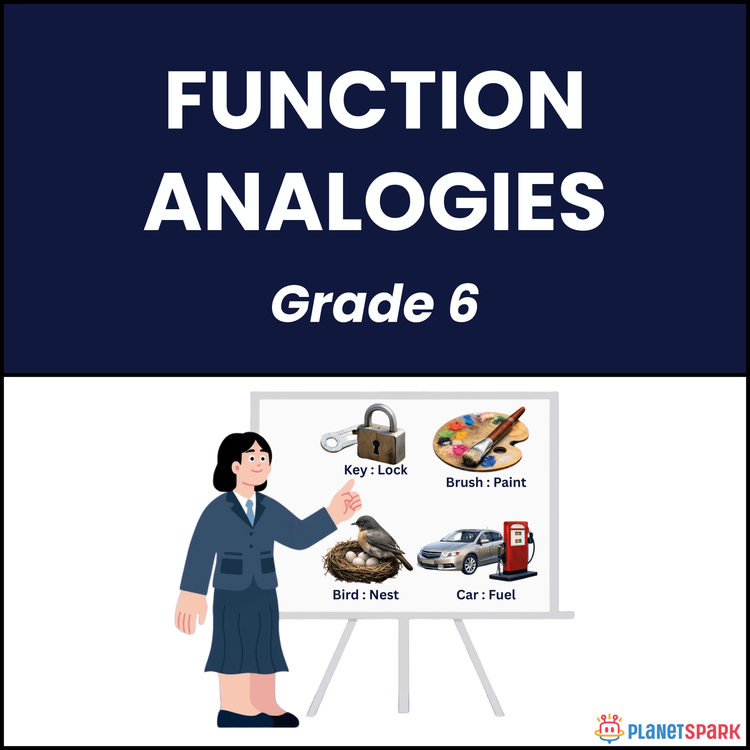
This Class 6 worksheet focuses on function analogies, helping students develop a strong understanding of how objects relate based on their purpose or function. Through engaging exercises, learners will practice identifying and completing analogies, enhancing their logical thinking and grammar skills.
Why Function Analogies Matter in Grammar?
Function analogies are essential because they teach students to recognize the relationships between objects based on their function. This helps improve critical thinking, vocabulary, and sentence construction. Understanding analogies aids in developing better sentence structure and communication skills.
What’s Inside This Worksheet?
This worksheet includes five engaging activities designed to build mastery of function analogies:
Exercise 1 – True/False
Students read statements about function analogies and determine if they are true or false.
Example: "A function analogy compares objects by what they are used for."
Exercise 2 – Match the Columns
Students match objects with their correct functions or purposes.
Example: "Thermometer" matches with "Measure."
Exercise 3 – Fill in the Blanks
Students complete function analogies by filling in the blanks with the correct words.
Example: "A spoon is to scooping soup as a fork is to stabs."
Exercise 4 – Choose the Correct Analogy
Students choose the correct word to complete the analogy.
Example: "Scissors : Cut :: Funnel : Pour."
Exercise 5 – Sentence Rewriting
Students rewrite sentences using correct function analogies.
Example: "A rolling pin is to flattening dough as a grater is to stirring."
Answer Key (For Parents & Educators)
Exercise 1 – True/False
1. True
2. True
3. False
4. True
5. False
6. True
7. True
8. False
9. True
10. True
Exercise 2 – Match the Columns
1-Thermometer : Measure
2- Compass : Navigate
3- Shield : Protect
4- Microscope : Magnify
5- Sponge : Absorb
6- Brake : Stop
7- Key : Unlock
8- Anchor : Secure
9- Oven : Bake
10- Lungs : Breathe
Exercise 3 – Fill in the Blanks
1. making holes (or drilling / boring)
2. piercing food (or stabbing / picking up)
3. flying (or gliding)
4. tracking time (or telling time)
5. displaying images (or showing text / viewing)
6. cleaning dishes (or washing plates)
7. healing broken bones (or protecting fractures)
8. tying shoes (or securing footwear)
9. cutting grass (or mowing lawns)
10. sheltering families (or living in / providing a home)
Exercise 4 – Choose the Correct Analogy
1. d) Pour
2. b) Magnify
3. a) Lift
4. c) Slow down
5. b) Swing
6. a) Pluck
7. d) Insulate
8. c) Measure speed
9. a) Gather
10. b) Stop
Exercise 5 – Sentence Rewriting
1. A rolling pin is to flattening dough as a grater is to shredding (or grating).
2. A hammer is to pounding nails as a wrench is to tightening (or turning/loosening bolts).
3. A hose is to spraying water as a wheelbarrow is to carrying (or transporting/moving dirt).
4. A stapler is to fastening papers as a hole punch is to making holes (or punching holes).
5. A microphone is to capturing sound as a speaker is to broadcasting (or projecting/outputting sound).
6. Bones are to supporting the body as muscles are to moving (or creating movement).
7. An airplane is to flying through air as a submarine is to diving (or submerging/navigating underwater).
8. Gloves are to keeping hands warm as swimming goggles are to protecting (or seeing underwater).
9. Gills are to breathing underwater as tree roots are to absorbing (or drawing water/anchoring).
10. A stethoscope is to listening to a heartbeat as a syringe is to injecting (or drawing fluids).
Help your child master function analogies today with a Free 1:1 Grammar Skills Trial Class at PlanetSpark.
Book a free trial!
Frequently Asked Questions
Function analogies show how an object or tool serves a specific purpose, helping students understand how things work in different contexts.
A simple examples include "scissors:cut," "pen:write," and "flashlight:light," which demonstrate the relationship between tools and their uses.
Students can practice by observing objects around them and thinking about their specific functions, like "spoon:eat" or "phone:call."