
Class 6 Prefixes In Im Il Ir Grammar Worksheet

Class 6 Prefixes In Im Il Ir Grammar Worksheet
The Negation Ninjas: Prefixes In-, Im-, Il-, Ir- for Class 6
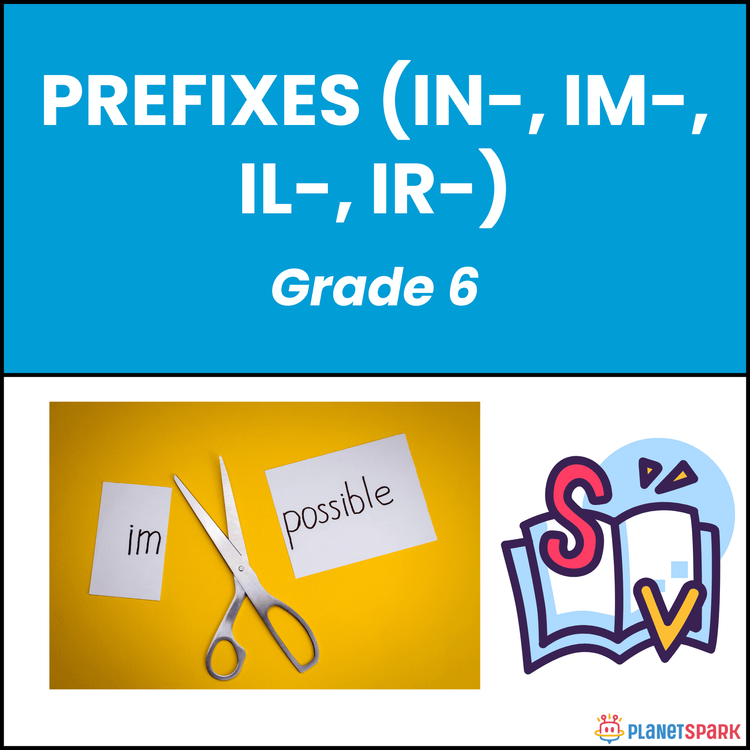
This Grade 6 worksheet focuses on the four negative prefixes in-, im-, il-, and ir- — all derived from the Latin prefix meaning ""not"" or ""the opposite of."" Students learn the spelling rules that determine which prefix to use: in- is used before most consonants (incorrect, inactive, indirect), im- is used before b, m, and p (impossible, impatient, immature), il- is used before l (illegal, illegible, illogical), and ir- is used before r (irregular, irrelevant, irresponsible). Through five targeted activities — matching prefixes to base words, sorting words by prefix type, fill in the blanks, multiple choice questions, and sentence rewriting — learners develop a thorough understanding of these prefixes and their correct usage. The exercises provide extensive practice with words commonly encountered in academic writing, everyday conversation, and competitive examinations. This worksheet is an essential resource for building spelling accuracy, vocabulary range, and grammar confidence in Grade 6 students.
Why Prefixes In-, Im-, Il-, and Ir- Matter in Grammar?
Negative prefixes are among the most frequently tested word-formation concepts in school-level English. For Grade 6 learners, mastering these prefixes is important because:
1. These prefixes follow specific spelling rules based on the first letter of the base word, making them both logical and predictable.
2. They are used extensively in academic writing, formal communication, and competitive exam vocabulary sections.
3. Misusing these prefixes (e.g., writing ""inpossible"" instead of ""impossible"") is a common error that this worksheet helps eliminate.
4. Understanding these prefixes enables students to quickly deduce the meaning of new words they encounter in reading.
What's Inside This Worksheet?
This worksheet includes five grammar-rich activities that build fluency with in-, im-, il-, and ir- prefixes:
Exercise 1 – Match Prefixes to Base Words
Students match each prefix on the left to its correct base word on the right. For example, ""in-"" matches with ""correct"" to form ""incorrect,"" ""im-"" matches with ""patient"" to form ""impatient,"" ""il-"" matches with ""legal"" to form ""illegal,"" and ""ir-"" matches with ""regular"" to form ""irregular."" This activity reinforces prefix-spelling rules and base-word identification.
Exercise 2 – Sort the Words
Students sort given base words into Prefix In- (and its variants) and Not In- categories. Words like active, pure, legal, regular, possible, and logical go under Prefix In-, while words like resolve, ject, port, illness, and ignore go under Not In-. This builds analytical sorting skills.
Exercise 3 – Fill in the Blanks
Students choose the correct prefixed word from each pair to complete sentences. For example: ""Rahul's handwriting was so ___ (illegible/illogical) that no one could read it."" The correct answer is ""illegible."" This exercise strengthens contextual usage of negative prefixes.
Exercise 4 – Multiple Choice Questions
Students select the correct prefix word from four options. For example: ""The boy is very ________ in sports. a) indirect b) illegal c) impure d) inactive."" The correct answer is ""inactive."" This sharpens quick identification of the right prefix-spelling combination.
Exercise 5 – Rewrite the Sentences
Students rewrite each sentence by replacing the positive base word with the correct negative prefix form. For example: ""Anjali found the math sum very possible to complete today."" becomes ""Anjali found the math sum impossible to complete today."" This exercise builds editing and vocabulary transformation skills.
Answer Key (For Parents & Educators)
Exercise 1 – Match Prefixes to Base Words
1. in- → correct (incorrect)
2. im- → patient (impatient)
3. il- → legal (illegal)
4. ir- → regular (irregular)
5. in- → active (inactive)
6. im- → possible (impossible)
7. il- → logical (illogical)
8. ir- → responsible (irresponsible)
9. im- → mature (immature)
10. il- → legible (illegible)
Exercise 2 – Sort the Word
Prefix In- and Im-: active, pure, direct, possible, soluble, complete, perfect, port
Prefix Il- and Ir-: legal, regular, logical, legible, literate, resolute, responsible
Exercise 3 – Fill in the Blanks
1. illegible
2. impatient
3. illogical
4. illegal
5. incorrect
6. illogical
7. impolite
8. immature
9. incomprehensible
10. incomplete
Exercise 4 – Multiple Choice Questions
1. d) inactive
2. a) indirect
3. d) impure
4. c) Illegible
5. a) irrelevant
6. d) irregular
7. a) incomplete
8. b) imperfect
9. a) illegal
10. c) Inaccessible
Exercise 5 – Rewritten Sentences
1. Anjali found the math sum impossible to complete today.
2. Rahul's reason for being late was totally illogical to the class.
3. Diya was told her answer in the test was incomplete and neat.
4. Pooja grew impatient after waiting for an hour at the bus stop.
5. Arjun's behaviour in the assembly was impolite and disruptive.
6. Kartik made an irresponsible decision to bunk the class today.
7. Neha said her younger brother was acting very immature at home.
8. Aarav's handwriting on the board was illegible and unreadable.
9. Rohan thought the new rule about no phones was irrelevant.
10. The student's argument in the debate was quite illogical today.
Give your child the power to use negative prefixes accurately and confidently with a Free 1:1 Word Building Trial Class at PlanetSpark. Our expert teachers make the spelling rules for in-, im-, il-, and ir- easy to remember through engaging practice activities.
Book a free trial!
Frequently Asked Questions
These prefixes negate or reverse the meaning of the word they are attached to, like "in-" in "incomplete" or "ir-" in "irregular."
Students often mix up the meanings of prefixes, especially when they appear to have similar meanings.
Worksheets provide activities where students add these prefixes to root words and understand how they alter meanings.