
Class 6 Grammar Worksheet on Cause-Effect Analogies

Class 6 Grammar Worksheet on Cause-Effect Analogies
Cause & Consequence: Mastering Cause–Effect Analogies for Class 6
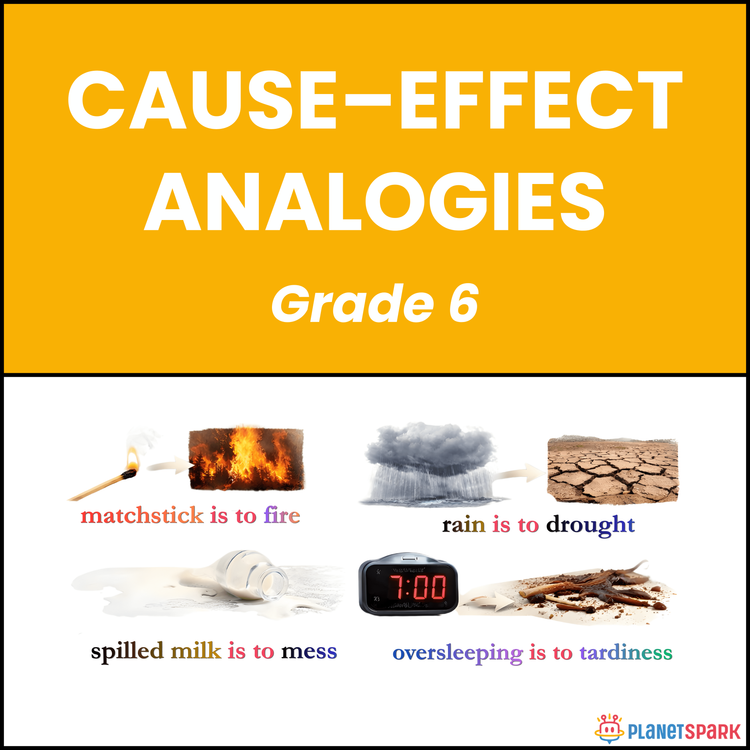
This Grade 6 English grammar worksheet focuses on Cause–Effect Analogies, helping students understand how actions lead to results and how ideas are logically connected. Through structured and engaging activities, learners explore relationships between causes and their effects in a clear and practical way.
This worksheet is designed to strengthen analytical thinking and grammar skills by guiding students through different formats such as True/False, matching, fill in the blanks, multiple choice questions, and sentence rewriting. Each activity encourages students to identify logical connections and apply them in meaningful contexts.
Why Cause–Effect Analogies Matter in Grammar?
Cause–effect relationships are essential for understanding how events are connected. For Grade 6 learners, this topic is important because:
1. It helps students recognize how one action leads to another.
2. It builds logical reasoning and critical thinking skills.
3. It improves sentence construction and comprehension.
4. It strengthens both writing clarity and reading understanding.
What’s Inside This Worksheet?
This worksheet includes five grammar-rich activities that build a strong understanding of cause–effect analogies:
Exercise 1 – True or False
Students read statements about cause–effect analogies and determine whether each statement is correct or incorrect.
Exercise 2 – Match the Following
Students match causes in Column A with their logical effects in Column B, reinforcing real-world connections.
Exercise 3 – Fill in the Blanks
Students complete analogies by identifying the correct effect that logically follows each cause.
Exercise 4 – Multiple Choice Questions
Students select the correct option to complete cause–effect analogies, improving accuracy and reasoning.
Exercise 5 – Sentence Rewriting
Students rewrite sentences using cause–effect analogies, helping them apply their understanding in context.
Answer Key (For Parents & Educators)
Exercise 1 – True/False
1. False
2. False
3. True
4. False
5. True
6. True
7. True
8. False
9. True
10. False
Exercise 2 – Match the Following
1. Gravity : Fall
2. Rain : Puddles
3. Effort : Success
4. Fatigue : Sleep
5. Practice : Skill
6. Winter : Shivering
7. Sun : Evaporation
8. Drought : Famine
9. Planting : Growth
10. Studying : Knowledge
Exercise 3 – Fill in the Blanks
1. Death / Sickness
2. Sorrow / Sadness
3. Thirst / Saltiness
4. Thanks / Gratitude
5. Disturbance / Chaos
6. Cold
7. Energy / Vitality
8. Blockage
9. Shouting / Redness
10. Recovery / Healing
Exercise 4 – Multiple Choice Questions
1. c) Tsunami
2. b) Smoothness
3. a) Immunity
4. d) Literacy
5. a) Recovery
6. b) Regret
7. d) Photosynthesis
8. c) Weight
9. a) Decay
10. b) Slippery
Exercise 5 – Sentence Rewriting
1. The heavy storm resulted in a Storm : Blackout analogy.
2. Her constant practice led to a Practice : Skill analogy.
3. The bright sun provided a Sun : Warmth analogy.
4. Driving at high speed caused a Speed : Accident analogy.
5. Telling a funny joke created a Joke : Laughter analogy.
6. The week of rain caused a Rain : Flood analogy.
7. Using plenty of soap leads to a Soap : Cleanliness analogy.
8. The long drought caused a Drought : Famine analogy.
9. Touching the sharp blade caused a Blade : Injury analogy.
10. The force of gravity results in a Gravity : Fall analogy.
Help your child build strong reasoning skills with cause–effect analogies and improve grammar confidence through structured practice today.
Book a free trial!
Frequently Asked Questions
Cause-effect analogies show the relationship between an action and its result, helping students understand how events are connected.
A simple examples include "fire:burn," "study:learn," and "heat:evaporation," showing how one event leads to another.
Practice identifying real-life causes and effects, such as "tornado:destruction" or "sunlight:plants grow," to connect actions and outcomes.